
You have probably seen the phrase “scarless” and felt two things at once: hope, and scepticism.
Hope, because the idea of fewer visible marks is appealing – especially if you have spent years avoiding mirrors, swimming pools, or fitted clothes. Scepticism, because surgery is surgery, and you want straight answers.
If you are researching scarless gastric sleeve Turkey clinics and packages, this article is for you. It is written for people who want the clinical facts, the real-world travel pathway, and the honest trade-offs – without the hype.
What “scarless gastric sleeve” actually means
A standard gastric sleeve (sleeve gastrectomy) is usually performed laparoscopically. That means several small incisions on the abdomen, through which a camera and instruments are used. The scars are typically small, but they do exist.
A “scarless gastric sleeve” most commonly refers to performing the sleeve using an approach designed to minimise visible abdominal scarring. In practice, this is often done by placing incisions in less noticeable locations, reducing the number of ports where clinically appropriate, and using careful closure techniques. Some clinics may describe this as “single incision” or “hidden incision” sleeve.
The key point: “scarless” is usually shorthand for “no obvious abdominal scars” rather than “no incisions at all”. Any provider who suggests there is literally no cutting involved should be challenged, because a true sleeve gastrectomy involves removing a portion of the stomach.
Why patients ask for scarless options in Turkey
For many UK and European patients, the decision to travel is not only about price. It is also about getting an organised, timely pathway with a team that does bariatrics every day.
Scar-minimising approaches have become a common question because they match what patients care about: confidence and comfort in your body, not just a number on the scales. If you are already making a life-changing commitment, it is natural to want to feel good about how you will look and heal afterwards.
There is also a practical angle. If you have a job that involves physical activity, if you wear fitted uniforms, or if you simply want to keep your surgery private, smaller and less visible scars can feel like one less “tell”.
Who is a good candidate (and when it depends)
Whether a scar-minimising sleeve is suitable depends on anatomy, safety, and surgical judgement – not preference alone.
If your BMI is higher, if you carry weight centrally, if you have a history of abdominal surgery, or if there is fatty liver enlargement, the surgeon may recommend a standard laparoscopic approach with multiple ports. That is not a downgrade. It is often the safest way to achieve good visibility, controlled stapling, and reliable haemostasis.
On the other hand, if your anatomy is favourable and your clinical work-up is reassuring, a reduced-scar technique may be an option. Your surgeon will balance cosmetic goals with the need for safe access, good staple line control, and a low risk of complications.
The most helpful mindset is this: aim for the safest operation with the best long-term result, and treat scar minimisation as a bonus when it genuinely fits.
What the surgery involves, in plain English
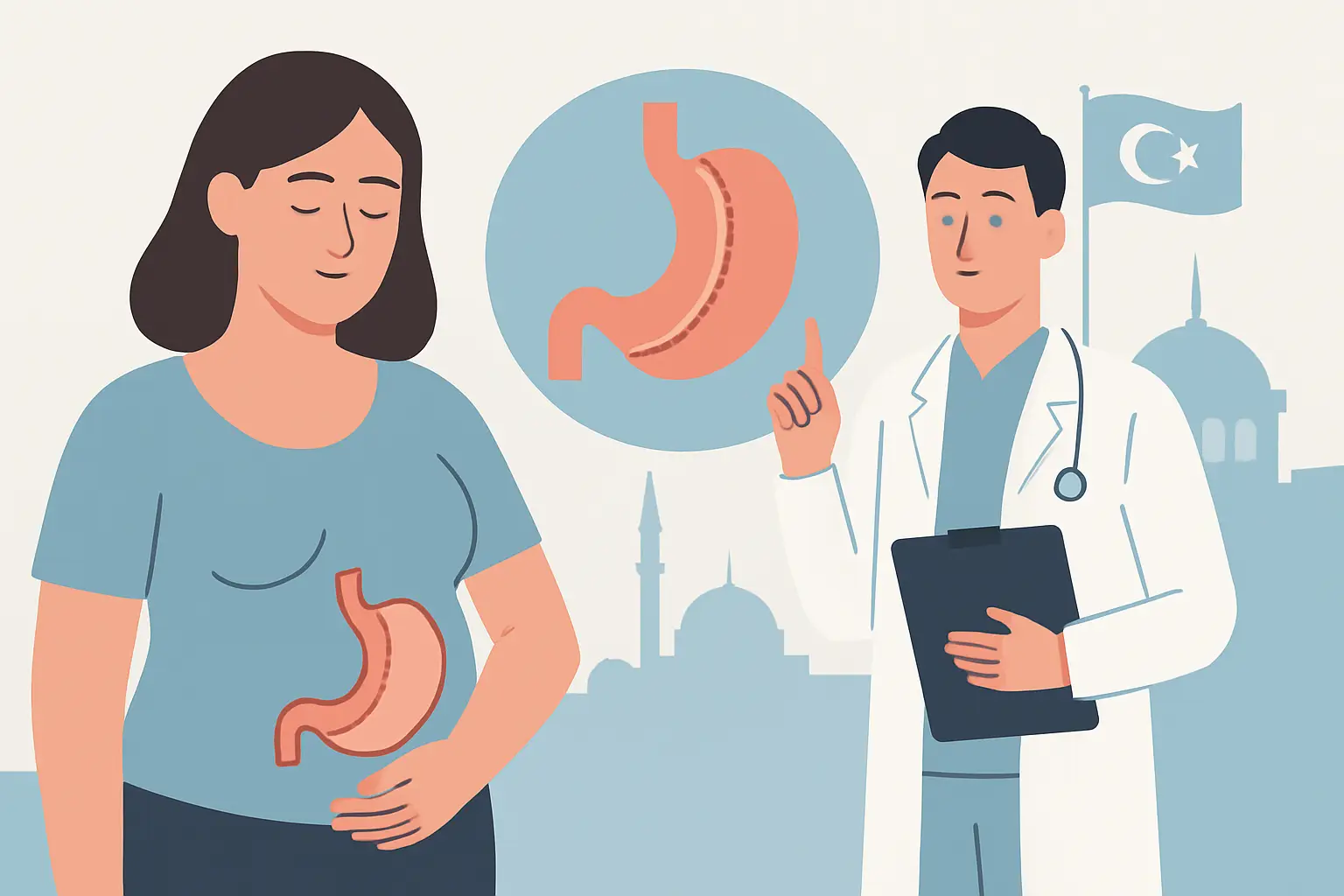
A gastric sleeve reduces the stomach to a narrow tube. The part of the stomach that is removed is the portion that stretches most easily and produces significant amounts of ghrelin, a hormone linked with hunger.
After surgery, you tend to feel full sooner and, for many people, appetite quietens down. You will still need to eat with structure and prioritise protein, hydration, and vitamins. The sleeve is a powerful tool, but it does not replace aftercare or behaviour change.
A scar-minimising approach does not change the fundamental goal or the internal result. It changes how the surgeon gets access.
Safety and results: what matters more than the scar
When patients compare options in Turkey, it can be tempting to focus on the headline feature – “scarless” – but the outcomes that matter are the ones you do not see:
Complication rates, infection control, anaesthetic standards, surgeon experience, and postoperative monitoring. A well-run bariatric programme is built around protocols: pre-op testing, VTE prevention, pain control, leak checks where appropriate, mobilisation, structured diet progression, and clear discharge planning.
It is also worth being honest about healing. Even with very small incisions, your body is still recovering internally. You will feel tired, you will need to walk frequently, and your relationship with food will change quickly. A smooth experience is not just about the operating theatre – it is about the days around it.
The Antalya patient journey: how it typically works
Most international patients want two things: predictability and support. The best experiences tend to follow a clear pathway.
Before you fly
You will usually share medical history, current weight and height, previous operations, medications, and any conditions such as reflux, sleep apnoea, diabetes, or high blood pressure. This is also the stage to be upfront about smoking and alcohol, because they affect healing.
A good team will explain what to stop and when (for example, certain blood-thinning medications) and what you need to bring, including any recent test results. You should also be told what to expect from the pre-op diet if one is required.
Arrival and settling in
Most patients appreciate not having to negotiate taxis, hotel check-ins, or language barriers while anxious. This is where medical travel coordination matters: a timed airport transfer, a hotel that suits recovery, and a plan for where your companion fits into the schedule.
Hospital day and pre-op tests
Expect pre-operative tests such as bloodwork, ECG, and imaging if required. You will meet the surgical and anaesthetic teams, go through consent, and discuss your individual risks.
This is also the moment to ask direct questions:
How many sleeves does the surgeon perform each week? What is the approach if a leak is suspected? What pain relief is standard? How is nausea managed? What is the plan for reflux if you already have symptoms?
A confident team will answer without defensiveness.
Surgery, mobilisation, and the first 24 hours
After surgery you will be monitored closely. Early walking is a priority – not because anyone wants to rush you, but because it reduces clot risk, helps lung function, and supports bowel recovery.
You will start sipping fluids according to your team’s protocol. Many patients are surprised by how small a sip needs to be at first. That is normal.
Discharge and back-to-hotel support
Discharge should come with written instructions: your medication plan (including stomach protection), hydration goals, diet stages, vitamin guidance, warning signs, and a clear way to contact the team.
This is also when scar care is discussed. With smaller incisions, the focus is usually keeping sites clean and dry, watching for redness or discharge, and avoiding heavy lifting until cleared.
Managing expectations about scars
Even with the most cosmetic-friendly technique, scars depend on how you heal.
Some people form darker marks (post-inflammatory hyperpigmentation). Some form raised scars. Others heal with barely a trace. Sun exposure can darken new scars, so covering them and using appropriate protection once healed can make a real difference.
If you are prone to keloids or hypertrophic scarring, say so early. It will not necessarily rule you out, but it changes the conversation. You may be advised on silicone gel or sheets once incisions are closed and your surgeon is happy.
Questions to ask any provider offering “scarless gastric sleeve Turkey”
Marketing terms are easy. Clinical clarity takes work. Ask:
- What technique do you mean by “scarless” and where are the incisions placed?
- How do you decide who is eligible for that approach?
- If you start scar-minimising, what would make you convert to standard laparoscopy during surgery?
- What is included in the package: hospital stay, tests, medications, follow-ups?
- How do you handle complications if they happen after I fly home?
A trustworthy answer sounds calm, specific, and safety-led.
Aftercare: the part that decides your long-term success
The first weeks are about healing and routine. The next months are about consistency.
You will progress through liquids to purees to soft foods and then to regular textures, based on your team’s plan. Protein first becomes a non-negotiable. Hydration becomes a daily job. Vitamins are not optional.
Emotionally, it can be strange. You may feel thrilled and fragile at the same time. Some people grieve old coping habits. Others feel relief because food noise quietens. Having structured check-ins and the ability to message questions makes a genuine difference when something feels “off” but you are not sure whether it is normal.
If you want a concierge-style pathway in Antalya that combines clinical coordination with travel logistics and ongoing check-ins, you can speak with Bridge Health Travel and ask specifically about scar-minimising sleeve options, eligibility, and aftercare support.
Cost, timing, and the hidden value of organisation
Turkey is often chosen because it can be more affordable than private surgery in the UK, and waiting times are usually shorter. But the patients who feel most at ease are typically the ones who know exactly what is included: transfers, hotel, tests, hospital length of stay, and how communication works day and night.
A lower headline price is not a bargain if you feel unsupported, rushed, or unclear about what happens if plans change. When you are travelling for surgery, organisation is part of safety.
Healing is rarely dramatic. It is mostly small decisions done repeatedly – a walk when you feel tired, a sip when you do not feel thirsty, a protein portion when your appetite is unpredictable. Choose the pathway that makes those decisions easier, and the confidence tends to follow.