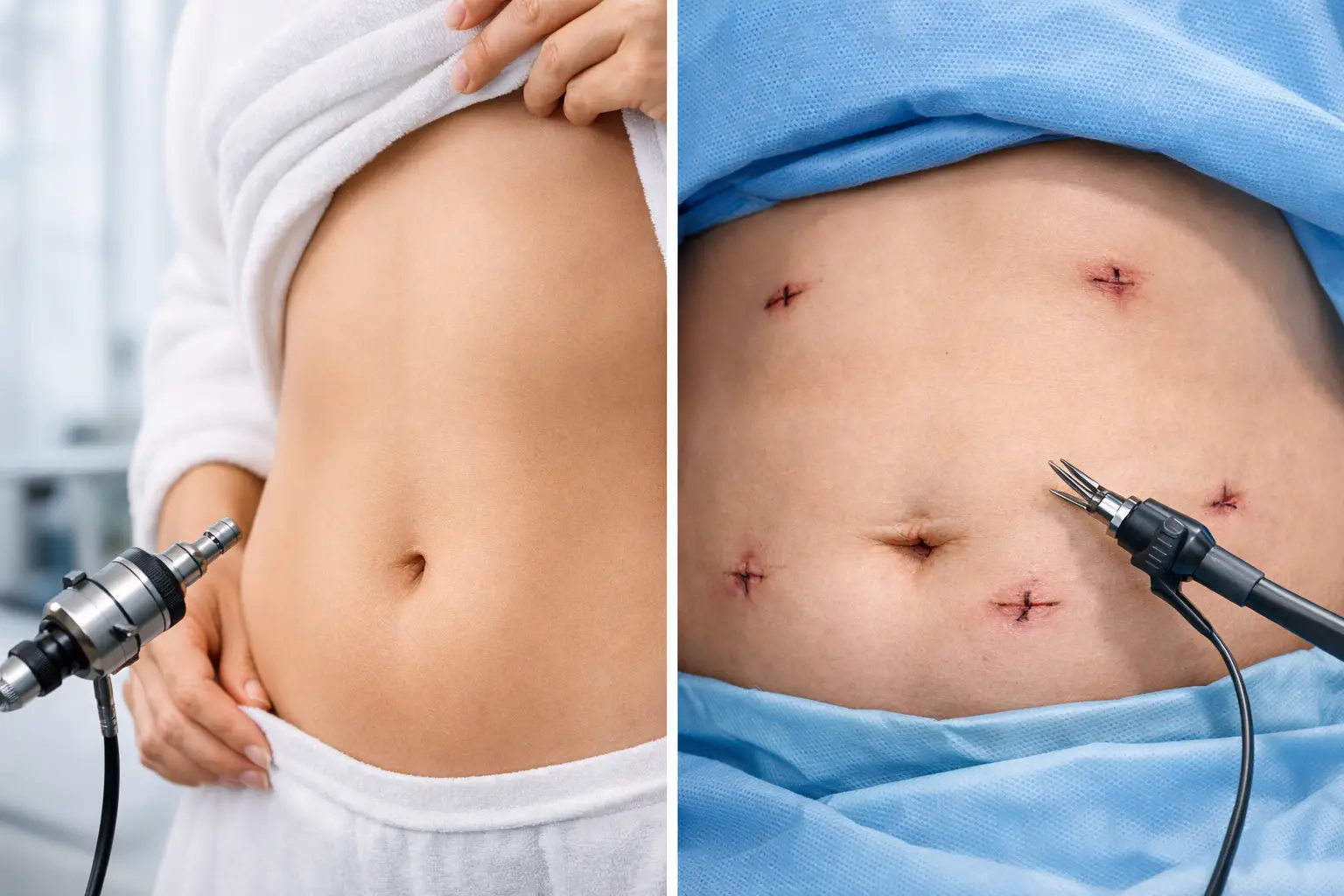

If you are weighing up scarless gastric sleeve vs standard sleeve, the real question is not which one sounds newer. It is which approach is safer and more suitable for your body, your medical history and your recovery priorities. For many patients, the difference comes down to surgical access rather than the weight-loss result itself.
Both procedures aim to do the same job. In each case, a large portion of the stomach is removed to create a narrow sleeve, helping you feel full sooner and eat less comfortably. The biggest distinction is how the surgeon reaches the stomach. That matters, but it is only one part of the decision.
Scarless gastric sleeve vs standard sleeve – what changes?
A standard gastric sleeve is usually performed laparoscopically through several small cuts on the abdomen. The surgeon uses these entry points for a camera and instruments, then removes part of the stomach through one of those openings. Because the cuts are small, the scars are often limited and fade well over time, but they are still external scars.
A scarless gastric sleeve is typically performed using a different access route, often through the belly button, with the aim of leaving no visible abdominal scars or making them far less noticeable. The stomach reduction itself is still a sleeve gastrectomy. Your digestion, expected weight loss and long-term dietary changes are not transformed simply because the entry point is different.
This is where expectations need to stay grounded. Scarless does not mean smaller surgery. It does not mean no internal healing. And it does not automatically mean an easier or safer recovery for every patient.
The main difference is cosmetic, not metabolic
Patients often ask whether scarless surgery works better. In most cases, the answer is no. The weight-loss mechanism is broadly the same because the operation on the stomach is the same. You are still reducing stomach volume, still following a staged post-operative diet and still relying on long-term habit change to protect your results.
Where the scarless approach may appeal is appearance. Some patients feel strongly about avoiding visible marks on the abdomen, especially if they are younger, prone to keloid scarring or simply want the most discreet result possible. That preference is valid. At the same time, it should be weighed against surgical practicality.
A standard sleeve gives the surgeon multiple access points and, in many cases, greater flexibility of movement. That can be especially useful in patients with higher BMIs, previous abdominal surgery, liver enlargement or anatomy that may make the operation more technically demanding. In bariatric surgery, the best cosmetic outcome should never come ahead of the safest operative plan.
Who is a better candidate for a scarless sleeve?
Not every patient is suitable for a scarless approach. Selection matters a great deal. A slimmer patient with no complex surgical history may be a more straightforward candidate than someone with significant central obesity, prior abdominal procedures or added risk factors that could make access more challenging.
This is why a proper pre-operative assessment matters more than the headline name of the procedure. Your surgeon will look at BMI, fat distribution, medical conditions, previous operations, hernia risk and imaging where needed. If a surgeon recommends a standard laparoscopic sleeve over a scarless option, that is not a downgrade. It is often a sign that safety and surgical control are being prioritised.
Patients travelling for surgery should be especially cautious about choosing a technique based only on social media clips or before-and-after promises. A well-run bariatric pathway includes bloods, ECG, imaging, anaesthetic review and a clear discussion of which procedure is actually appropriate for you – not just which one sounds most appealing online.
Recovery and pain – is there a real advantage?
This is one of the most common questions in the scarless gastric sleeve vs standard sleeve debate, and the honest answer is that it depends. Some patients assume fewer visible cuts mean less pain. Sometimes that is true. Sometimes it is not as simple as that.
Pain after sleeve surgery is influenced by more than skin incisions. Internal stapling, tissue handling, gas used during laparoscopy, muscle stretching and your own pain threshold all play a part. A scarless approach may reduce visible marking, but it does not remove the fact that your stomach has been surgically altered.
In practical terms, most patients are focused less on the number of cuts and more on how supported they feel in the first few days. Good pain control, early mobilisation, clear hydration guidance and close follow-up usually shape the recovery experience more than the cosmetic approach alone. Daily medical review, rapid nurse response and clear instructions can make a far bigger difference to confidence than one less visible scar.
Standard sleeve still has a strong cosmetic profile
The phrase standard sleeve can make it sound basic or old-fashioned, but that is misleading. Modern laparoscopic sleeve surgery is already minimally invasive. The incisions are small, and once healed, many patients find the scars are discreet. Over time they often fade considerably.
For some people, that changes the equation. If the expected scars are already limited, the extra value of a scarless approach may not feel significant enough to justify choosing it over the more conventional route. For others, even small visible scars matter. Neither view is wrong. It simply depends on what matters most to you and what your surgeon believes can be done safely.
Safety and surgeon experience matter more than the label
A scarless procedure should only be considered if the surgeon is experienced in that technique and if you are a suitable candidate. That point is worth stressing because patients sometimes compare procedures as if they are fixed products. They are not. Outcomes depend heavily on the team performing them, the hospital setting, patient selection and post-operative care.
The better question is not, “Which procedure is best?” It is, “Which approach gives me the safest operation and the best chance of a smooth recovery?” If that turns out to be a standard laparoscopic sleeve, that can still be an excellent choice. If you are well suited to a scarless technique and your surgeon performs it routinely, that may also be a strong option.
What you want is clinical honesty. You want a team willing to explain why one method fits you better than another, and willing to change the plan if your safety requires it. That is far more reassuring than being told what you want to hear.
Scarless gastric sleeve vs standard sleeve for travelling patients
If you are coming from the UK or Ireland for surgery, convenience and support matter alongside the clinical decision. Travelling for bariatric treatment can feel daunting enough without trying to interpret technical differences on your own. A clear plan helps – consultation, pre-op testing, surgery scheduling, hospital stay, hotel recovery, transfers and aftercare should all feel joined up rather than pieced together.
This is often where patients feel the greatest relief. When your coordinator, surgeon and hospital team are aligned, you are less likely to fixate on marketing terms and more likely to focus on the right questions. Am I suitable? What are the risks? What will recovery look like? Who do I contact if I feel unwell once I am home?
At Bridge Health Travel, those questions are part of the conversation because choosing between procedures is only one part of the journey. Feeling informed, looked after and medically guided from start to finish is what helps patients make calm, confident decisions.
Which one should you choose?
If your top priority is avoiding visible abdominal scars and you are a good candidate, a scarless sleeve may be worth discussing. If your anatomy, BMI or surgical history makes standard laparoscopy the safer route, then the standard sleeve is likely the better option. And if you are expecting better weight loss from one over the other, you may be focusing on the wrong difference.
The right procedure is the one that fits your body safely and gives your surgeon the best operating conditions. In bariatric surgery, the smartest choice is not always the newest-sounding one. It is the one that combines sound technique, appropriate patient selection and strong aftercare.
A good surgeon will never treat your decision like a sales choice. They will treat it like what it is – a major health step that deserves careful planning, honest answers and support that continues after the flight home.