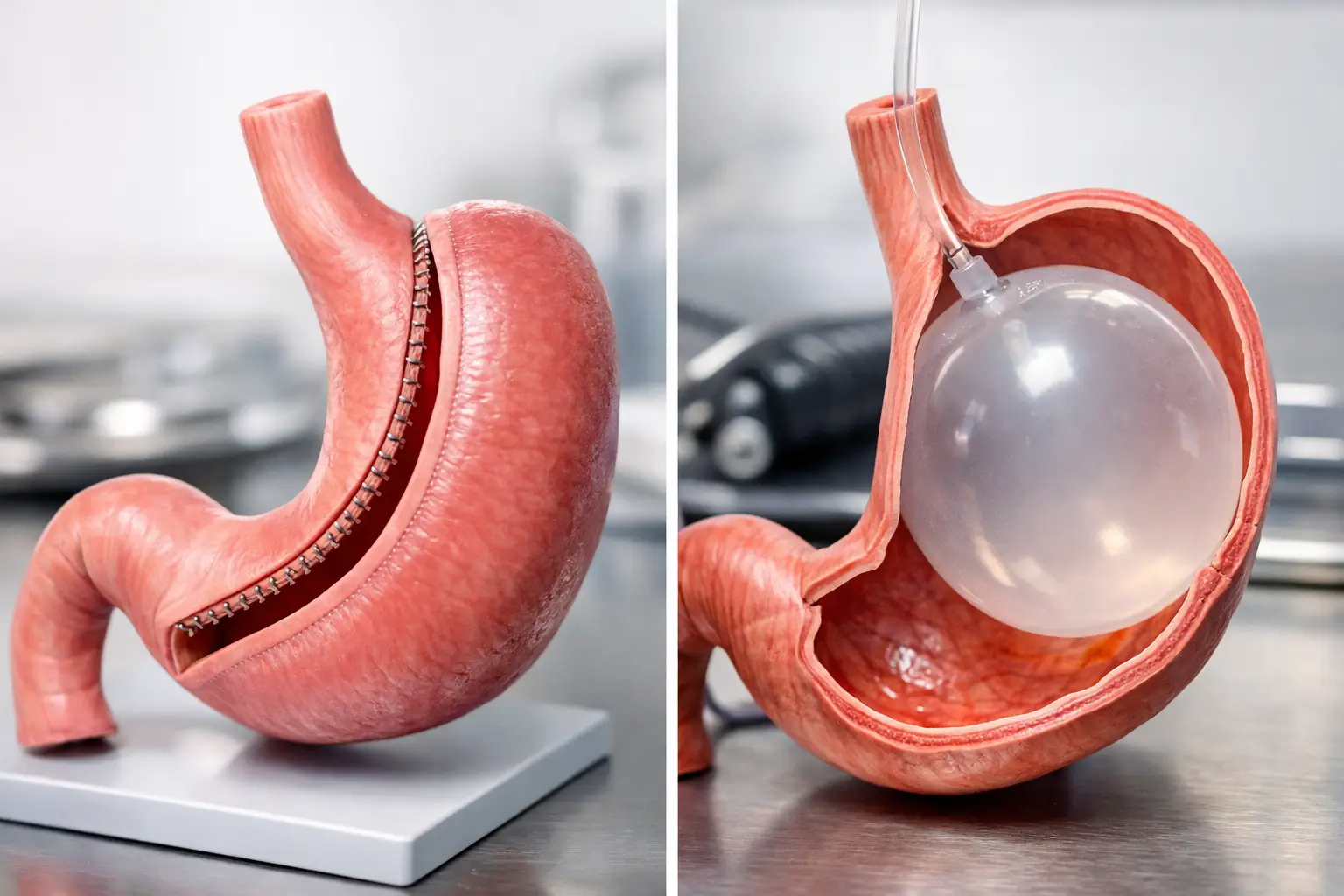

If you are weighing up gastric sleeve versus balloon, you are probably not looking for a sales pitch. You want a clear answer to a very personal question: which option is more likely to give you meaningful, lasting weight loss without putting you through more than you are ready for.
That answer depends on your starting weight, your medical history, your relationship with food, and how much change you need from the procedure. For some patients, a gastric balloon is a useful step. For others, it is simply too modest or too temporary, and a sleeve is the treatment that properly matches the problem.
Gastric sleeve versus balloon at a glance
Both procedures are used to support weight loss, but they work very differently.
A gastric sleeve is an operation that removes a large portion of the stomach, leaving a smaller sleeve-shaped stomach behind. This limits how much you can eat and also changes hunger hormones, which is one reason many patients notice a real drop in appetite after surgery.
A gastric balloon is not surgery in the same sense. A soft balloon is placed inside the stomach and filled to take up space. The goal is to help you feel full sooner and reduce portion sizes. It stays in place for a limited period, usually several months, and is then removed.
The simplest way to think about it is this: the balloon is temporary and less invasive, while the sleeve is permanent and typically far more effective.
Who usually suits each option?
This is where the decision becomes less about preference and more about clinical fit.
The gastric balloon may suit patients who want a non-surgical option, have a lower BMI than typical bariatric surgery patients, or need a shorter-term intervention to help them restart weight loss. It can also be considered for people who are not yet ready for surgery emotionally, financially or medically.
The gastric sleeve usually suits patients who need more significant weight loss, have obesity-related health issues, or have spent years trying diets, medications and exercise plans without durable results. If your excess weight is affecting mobility, fertility, sleep apnoea, blood pressure or confidence in daily life, the sleeve often offers the stronger long-term tool.
That does not mean the bigger procedure is always the right one. Some patients do well with a balloon because they are highly motivated, have a smaller amount of weight to lose, and mainly need structure and appetite control. Others know, quite honestly, that if the tool is removable and temporary, the result may be temporary too.
How much weight can you realistically lose?
This is usually the decisive factor.
With a gastric balloon, weight loss can be meaningful, but it is usually more modest. Results vary widely because success depends heavily on behaviour while the balloon is in place and after it comes out. Some patients do very well. Others regain weight once the balloon is removed, especially if eating habits have not changed enough during treatment.
With a gastric sleeve, expected weight loss is usually much greater. It is one of the reasons sleeve surgery remains one of the most popular bariatric procedures worldwide. Patients often lose a substantial amount of excess weight over the first 12 to 18 months, provided they follow dietary guidance and commit to long-term changes.
The trade-off is obvious. The balloon asks less of you upfront, but often gives less back. The sleeve asks more of you in terms of surgery and recovery, but usually offers a much stronger chance of lasting change.
Gastric sleeve versus balloon for appetite and eating habits
The day-to-day experience is not the same.
A gastric balloon creates restriction by physically occupying space in the stomach. You will feel fuller earlier, but many patients still experience hunger, cravings or emotional eating patterns that are not fully addressed by the balloon itself. If snacking, grazing or high-calorie liquids are part of the problem, a balloon may not always be enough.
A gastric sleeve changes stomach volume and affects hunger hormones in a more powerful way. Many patients report that food noise quietens down after surgery, particularly in the early months. That can make it easier to follow the new eating plan and build routines around smaller meals, better protein intake and more conscious choices.
Neither option does the emotional work for you. If food has become comfort, routine or stress relief, support still matters. The procedure helps create a window of opportunity. What you do with that window shapes the long-term result.
Recovery, downtime and the practical side
For anxious patients, this matters just as much as weight loss.
A gastric balloon is less invasive and recovery is usually quicker. That said, the first few days can be unpleasant. Nausea, cramping, reflux and vomiting are common while the stomach adjusts. Some people settle quickly; others find the balloon harder to tolerate than they expected.
A gastric sleeve involves hospital care, anaesthesia and a proper surgical recovery period. Most patients need time off work and a staged diet as the stomach heals. It is a bigger step, but recovery is structured, and many patients feel that the temporary disruption is worth it for the quality of the result.
If you are travelling for treatment, logistics also matter. Coordinated airport transfers, pre-operative testing, hospital scheduling, translation support and clear aftercare can make a very real difference to how manageable the experience feels, especially for patients coming from the UK or Ireland who do not want to piece everything together alone.
Risks and limitations to understand clearly
Every bariatric treatment has risks, and no reputable team should gloss over them.
The gastric balloon may seem simpler, but it is not risk-free. Some patients cannot tolerate it and need early removal. Reflux, nausea and discomfort are common at the start. There is also the larger limitation that it does not offer permanent anatomical change, which is why weight regain can be a concern.
The gastric sleeve carries surgical risks, including bleeding, infection, leakage and complications related to anaesthesia. Long-term, some patients experience reflux or need careful nutritional follow-up. It is not a casual decision, and it should always involve proper assessment and surgeon review.
What often reassures patients is not hearing that risk is absent, but knowing the process is thorough. Pre-op bloods, ECG, imaging, medical review, experienced bariatric teams and clear post-op monitoring all exist for a reason. Good care is built on detail.
Cost matters, but value matters more
It is understandable to compare price first. Many international patients do.
A gastric balloon is usually cheaper than a sleeve at the outset. That lower entry point can make it appealing. But if the result is limited, temporary or followed by regain, it may not be the better value over time.
A gastric sleeve costs more because it is surgery, requires a hospital stay and involves a more complex clinical pathway. Even so, many patients consider it better value because the weight loss is typically stronger and the long-term impact on health, confidence and daily function can be much greater.
This is especially relevant for patients who have already spent years paying for slimming clubs, private prescriptions, injections, personal trainers and restart-after-restart diet plans. Sometimes the less expensive option is only cheaper on paper.
Questions that help you choose honestly
If you are stuck between the two, the right question is not Which procedure sounds easier? It is Which procedure matches the size of my problem?
Ask yourself how much weight you need to lose, whether you need a permanent tool, whether previous non-surgical methods have truly worked, and how likely you are to maintain progress after a temporary device is removed. Think about your health as it stands now, not only your hopes for the future.
It also helps to be honest about timing. If you need a bridge treatment, are not currently fit for surgery, or want a less invasive first step, the balloon may have a place. If you need a decisive intervention with stronger metabolic and appetite effects, the sleeve is often the clearer route.
At Bridge Health Travel, this is exactly why proper patient coordination matters. The best treatment choice is not the one that sounds most appealing online. It is the one that fits your medical profile, your goals, and the level of support you need to follow through.
Which one is better?
For most patients seeking significant and durable weight loss, the gastric sleeve is the more effective option. It tends to produce better long-term results and gives patients a stronger physiological advantage in the months when new habits are being formed.
But better does not always mean right for everyone. The balloon can still be a sensible option in carefully selected cases, particularly when surgery is not appropriate or when a patient wants a temporary tool with less upfront intensity.
If you are torn between the two, you do not need more hype. You need a proper assessment, a realistic conversation about outcomes, and a plan that feels medically sound as well as emotionally manageable. The right decision should leave you feeling informed, not pressured – and confident that you are choosing something that supports the life you want to get back to.